Contemporary Zimbabwean Art
Zimbabwe has always been known as one of the sub-continent’s most creative countries. It is not surprising that the first contemporary art movement to come out of sub-Saharan Africa was from Zimbabwe, her sculpture in stone. Emerging onto the international art scene in the 1970’s, it was described at the time as ‘one of the most compelling art forms to come out of contemporary Africa.’ (Ray Wilkinson) Within a decade, it had been exhibited in major Western Museums, the Museum of Modern Art in New York, the Musee de Rodin in Paris, and the Institute for Contemporary Arts in London. The artists chosen medium was a ‘touchstone’ to a simultaneously past and present reality, the granite domes and outcrops of the country were part of the cultural and spiritual landscape. Serpentine was freely available, being quarried in the country, tools were made by hand, no machines were ever used, and it became the medium for black artists to express their own psychic identity in a milieu in which all things African, in the colonial milieu of the time, were regarded as inferior. The unforgiving medium of stone yielded to the ‘I -Thou’ relationship of African consciousness, of being at one with the rhythm of things. This was the elemental power of these early forms, and the reason it made such an impact on the international art world. Forms which expressed a powerful energy that was a statement of being, whether human, animal or even hybrid, being as simultaneously transcendent and actual.
Contemporary art survives only in collaboration with audience, patron, market, the relationships every artist must negotiate. The first Director of the Rhodes National Gallery, now the National Gallery of Zimbabwe, Frank McEwan, came to the newly opened Gallery in 1957 straight from the art world of Paris and a close association with Picasso. Steeped in the aesthetic of the avant-garde of Paris, he recognized the same in the black artists of Zimbabwe, in a society polarized between African and European, and he opened a way for black artists that was not there for them before. The art critic Michael Shepherd wrote in Art Review of 1988, that on the passing of Henry Moore, the position of the greatest living sculptor had three contenders, and ‘all three’ were from Zimbabwe.
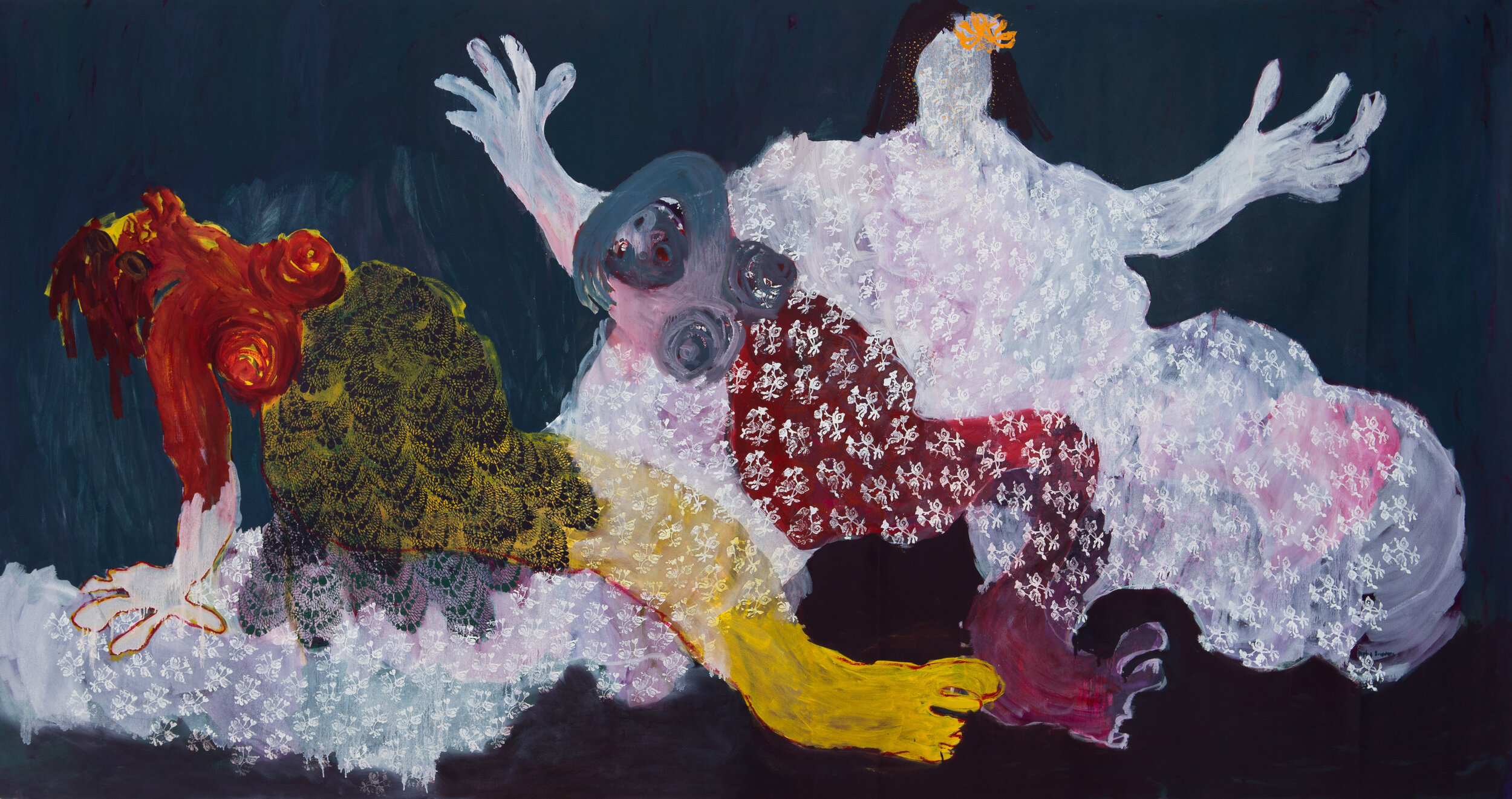
Portia Zvavahera, 2016, Embraced and protected in you, printing ink and oil bar on canvas, 210 x 400cm. Copyright the artist, courtesy Stevenson Gallery, Cape Town/Johannesburg
It is not so easy to erase an aesthetic consciousness, an awareness of the deeper questions and dimensions of life, which was what drove the emergence of Zimbabwe’s stone sculpture. The same desire to express the human condition is behind a second contemporary art movement from Zimbabwe, making its mark on the international art world, the work of her young painters. These artists are speaking from their everyday experience of Zimbabwe’s spiral of disintegration. Their work strives to interpret who and where is the self, in a situation which has gone so far beyond the ordinary that it is not easy to describe in words. This time it is paint, photography, graphics, and found objects in a bricolage of township life, multi-media applied in bold gestural strokes and vibrant colour, which coalesce into personal metaphors, commentaries on meaning where meaning as a shared security has vanished.
Although not exhaustive, nevertheless the following artists are prominent in a remarkable body of painting coming out of Zimbabwe, Kudzanai Chiurai, Virginia Chihota, Misheck Masamvu, Gareth Nyandoro, Gresham Tapiwa Nyaude, Portia Zvavahera, Amanda Mushate, Admire Kamudzengerere, Lovemore Kambudzi, Richard Mudariki, Wycliffe Mundopa, Moffat Takadiwa. The Zimbabwean capital, Harare, worldly in its hustle and struggle, has become a mecca for ‘international gallerists and collectors’ to quote Valerie Kabov, its artists committed to succeeding on their own terms.
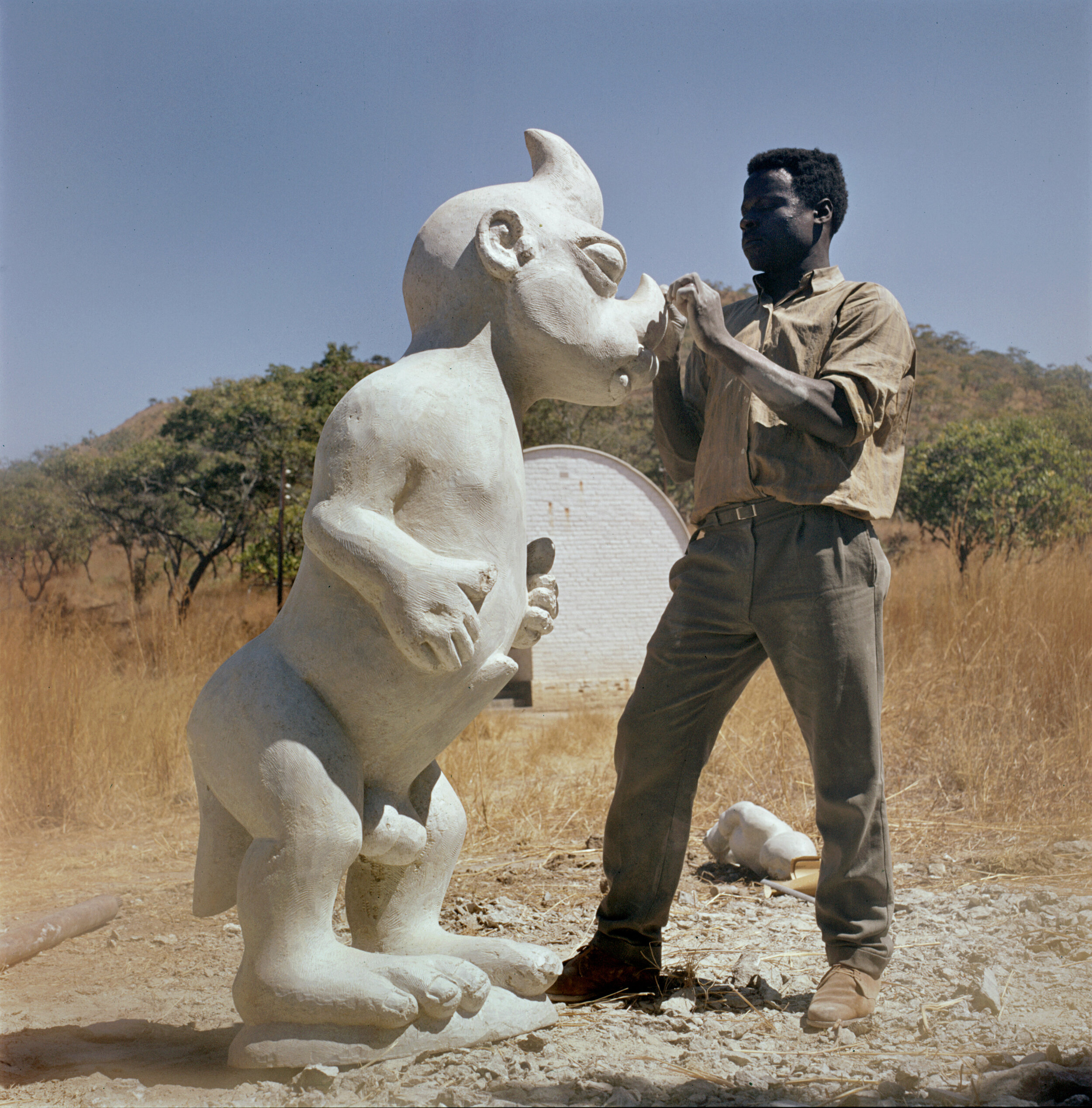
Bernard Matemera, one of the major 1st generation Zimbabwean stone sculptors, at work, 1975